



Chandler Airport (CHD) recently completed an Airport Strategic Business Plan, noting an airport weakness is the runway length, and opportunities which include the local economy due to strong demographics, and the economic impact of the airport to the community. The Strategic Business Plan developed 70 goals, with five priority goals, one of which was to complete a Community Impact Study and revisit a possible runway extension.
The Study focuses on why a runway extension is important and how it could benefit the community. A critical component of the Study is connecting with the community and fostering relationships to build understanding of how Chandler Municipal Airport is a community asset that should be further developed.
Chandler Municipal Airport: A Community Asset
Chandler Municipal Airport (CHD) is known as a General Aviation (GA) airport, which provides aircraft and pilot services, and acts as a “reliever” for larger airports, like Sky Harbor. Otherwise, the larger passenger planes that frequent Sky Harbor, and their passengers, would experience major schedule delays by making way for the smaller planes and jets that utilize GA airports like Chandler. In addition to serving local and visiting aviation enthusiasts, Chandler airport is also home to local public safety services for law enforcement (police), medical emergencies (medivac), organ transplant transport, search and rescue, and Civil Air Patrol.
The market assessment for Chandler Municipal Airport, as part of the Strategic Business Plan, includes $55 million in total impact on the state’s economy, nearly 500 total jobs, 58,600 out-of-state visitors spending $11.5 million and more than $20 million in employee earnings.
The Importance of a Runway Extension
Unlike many other GA airports, Chandler Airport works at a disadvantage as many planes and jets cannot land or take-off at Chandler during the summer due to the runway length, shorter than needed by 680 feet. To understand the importance of this additional 680 feet, we’ve developed a very informative video and several exhibits to help convey its necessity.
We’d like to shed some light on some common misunderstandings about a runway extension:
- A runway “extension” is not an “expansion” of the airport. The runway length will be extended; however, this will not expand the airport’s operations but remedy the fact that the planes/jets that use Chandler Airport today cannot land during the hotter temperatures in Chandler.
- A runway “extension” is within the existing Chandler airport boundary, there is no need for additional property or even relocating existing perimeter fence.
- There is no plan for larger commercial-type planes or jets to access Chandler airport, nor could they, given the airfield pavement structure needed.
- While noise is a dynamic feature of every airport, as a runway “extension” will not accommodate larger aircraft, significant changes to the airport’s noise footprint are not likely.
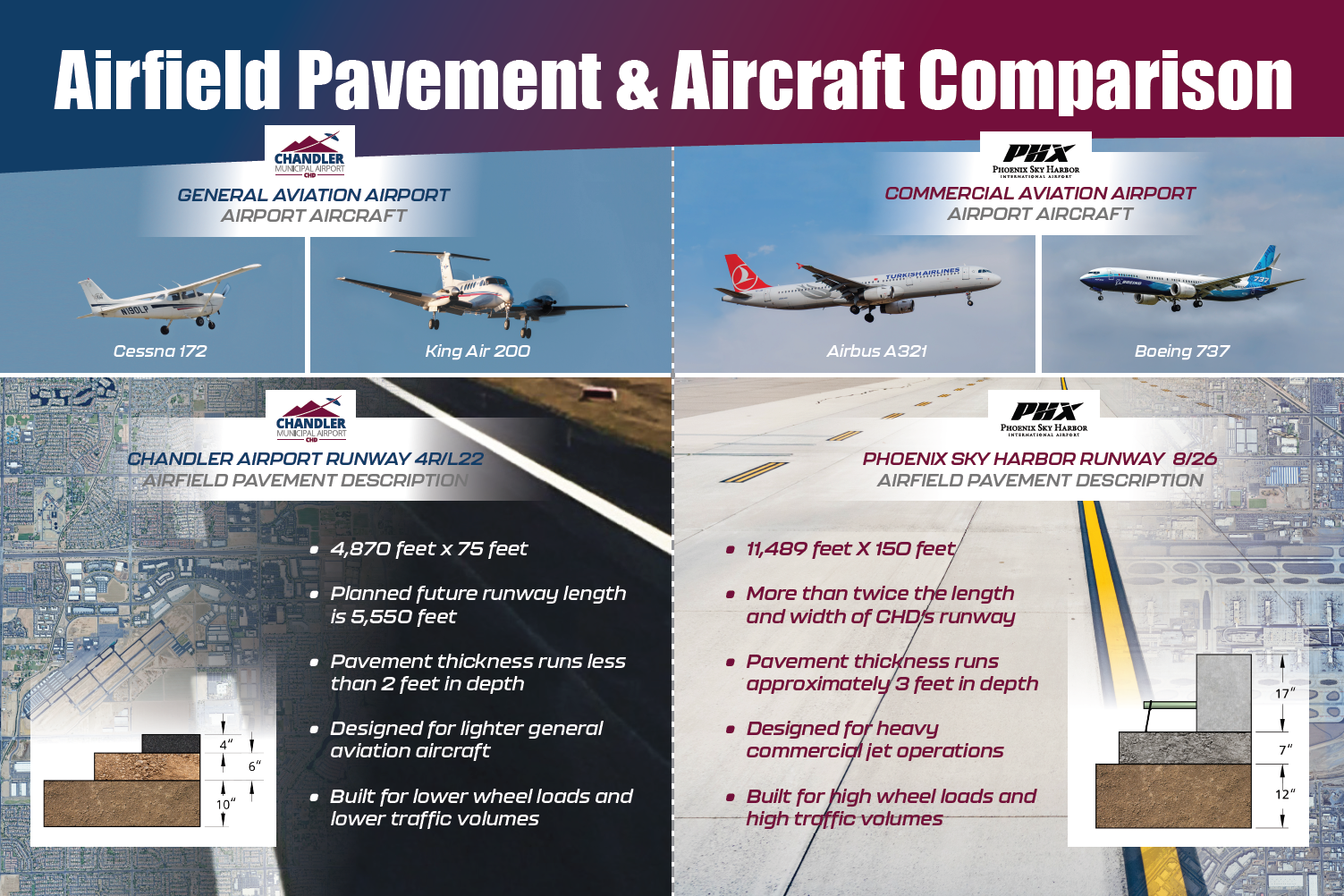
Airfield Pavement & Aircraft Comparison
Chandler Municipal Airport
General Aviation Airport
Aircraft Examples
Cessna 172 and King Air 200
Chandler Airport Runway 4R/L22
Airfield Pavement Description
- 4,870 feet x 75 feet
- Planned future runway length is 5,550 feet
- Pavement thickness runs less than 2 feet in depth
- Designed for lighter general aviation aircraft
- Built for lower wheel loads and lower traffic volumes
Phoenix Sky Harbor Airport
Commercial Aviation Airport
Airport Aircraft Examples
Airbus A321 & Boeing 737
Phoenix Sky Harbor Runway 8/26
Airfield Pavement Description
- 11,489 feet x 150 feet
- More than twice the length of and width of CHD’s runway
- Pavement and thickness runs approximately 3 feet in depth
- Designed for heavy commercial jet operations
- Built for high wheel loads and high traffic volumes
General aviation includes all civilian flying that is not commercial airline service or military aviation. At Chandler Municipal Airport, general aviation activity includes business aircraft used by local companies, flight training and pilot education, emergency and medical flights, law enforcement and public safety operations, and recreational or personal flying.General aviation airports like Chandler Municipal Airport play a critical role in regional transportation, economic development, and emergency response.
In summary, airports like Chandler do not have jumbo jets thundering down the runway, but they’re essential threads in the region’s transportation network, economic vitality, and emergency response capabilities.
Airports serve so many functions that are essential to our communities.
Airports in the United States generally fall into several categories based on the type of aviation they support. Commercial service airports provide scheduled airline service, such as Phoenix Sky Harbor. General aviation airports operate without airline service and support a wide range of non-commercial and commercial aviation activity, such as Chandler Municipal Airport. Some general aviation airports, including Chandler, are designated as reliever airports, meaning they help reduce congestion at nearby commercial airports by accommodating non-airline traffic.
Commercial airline operations require airline terminals, passenger screening facilities, FAA Part 139 certification, much stronger pavements designed for heavy aircraft, and larger safety areas and airfield infrastructure —none of which exist at CHD, and none of which are planned, designed or desired. The proposed runway extension does not change this.
Chandler Municipal Airport primarily serves single-engine and multi-engine propeller aircraft, turboprops such as the King Air, and small to mid-size business jets such as Cessna Citation aircraft. What you won’t find are the big, commercial jets—no Boeing 737s or Airbus A320s squeezing in here. CHD prefers to keep things cozy, quick, and charmingly small-scale. The Airport is also limited by its infrastructure including its pavement depth to the size of aircraft that can land and takeoff.
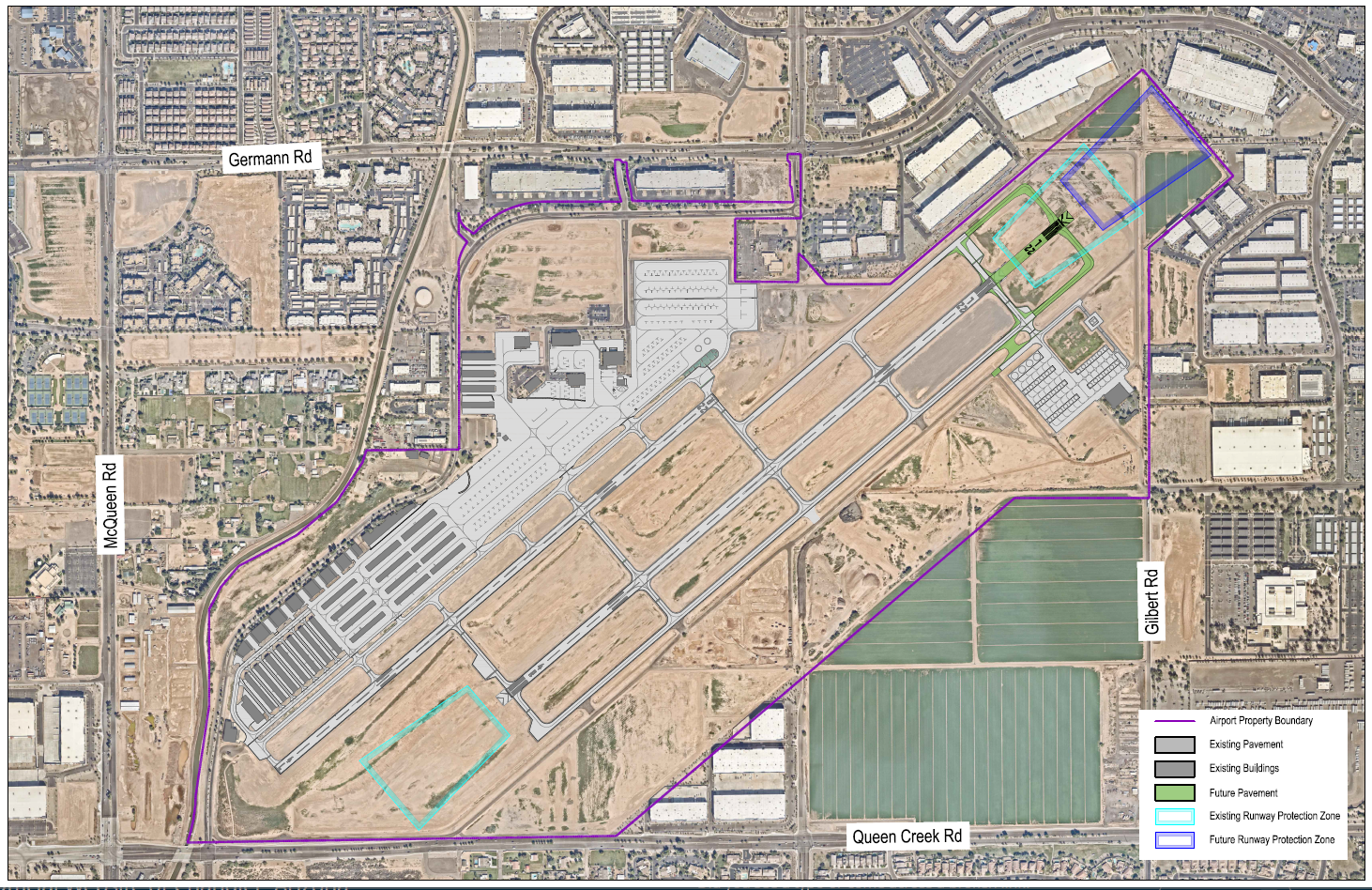
Chandler Municipal Airport isn’t trying to sprawl or stretch its borders—it’s staying right where it is. The airport’s physical footprint is not expanding. The runway extension remains entirely within existing airport property and does not change the airport’s role, mission, or surrounding land use compatibility.
Airport planning typically looks 20 years or more ahead to ensure safety, efficiency, and compatibility with surrounding communities. Long-term planning allows airports to make incremental improvements, such as the proposed runway extension, rather than reacting to safety issues after they arise.
Municipalities, counties, and airports think in decades because the systems they manage are big, expensive, slow to change, and deeply interconnected. A long-range master plan isn’t a luxury—it’s the only way to keep complex infrastructure, like CHD airport, functioning and futureproofed.
Owned and operated by the City of Chandler, the Chandler Municipal Airport supports local businesses and jobs, provides emergency and medical access, supports pilot training and workforce development, and functions as a reliever airport for Phoenix Sky Harbor by reducing congestion in the regional aviation system.
Even residents who never use the airport benefit from its role in maintaining a safe, efficient, and resilient regional transportation network.
Most eligible airport capital projects at public-use airports like CHD are funded through the Federal Aviation Administration’s Airport Improvement Program (AIP). For general aviation reliever airports, AIP typically covers over 90 percent of eligible project costs.
These federal funds come from the Airport and Airway Trust Fund, which is supported by aviation user taxes and fees, not local property or sales taxes. In other words, runway projects aren’t dipping into the pockets of Chandler residents.
No. Local property taxes are not used to fund FAA-eligible runway improvements. The local share, typically about 10 percent, is usually funded through airport revenues such as fuel sales, hangar leases, and other aviation-related fees, not general city taxes.
Public-use airports like CHD are part of the National Plan of Integrated Airport Systems (NPIAS), which means they serve a broader regional and national transportation role. Because the airport benefits the national aviation system, federal funding helps pay for safety-related infrastructure rather than placing the full cost on local users or the city. This is a bit like everyone pitching in for a shared roadway: the benefits reach far beyond the people who happen to drive on it every day, so the burden doesn’t fall solely on local pilots or the city.
Chandler Municipal Airport currently supports approximately 569 jobs, generates $150 million in annual economic output, and contributes about $2.5 million per year in state and local tax revenues, including roughly $622,000 annually to the City of Chandler. The runway extension helps protect and sustain these existing economic benefits by keeping CHD competitive and safe for the businesses that already rely on it. The proposed runway extension isn’t about chasing something bigger; it’s about safeguarding what already works.
Even if you never set foot inside Chandler Municipal Airport, it’s still quietly working in your favor. Chandler Municipal Airport functions as a reliever airport for Phoenix Sky Harbor. Every general aviation or business flight that uses CHD instead of Sky Harbor (PHX) reduces congestion at PHX, helping airline flights operate more efficiently. This benefits residents through reduced delays, smoother airline operations, and a more reliable regional air transportation system.
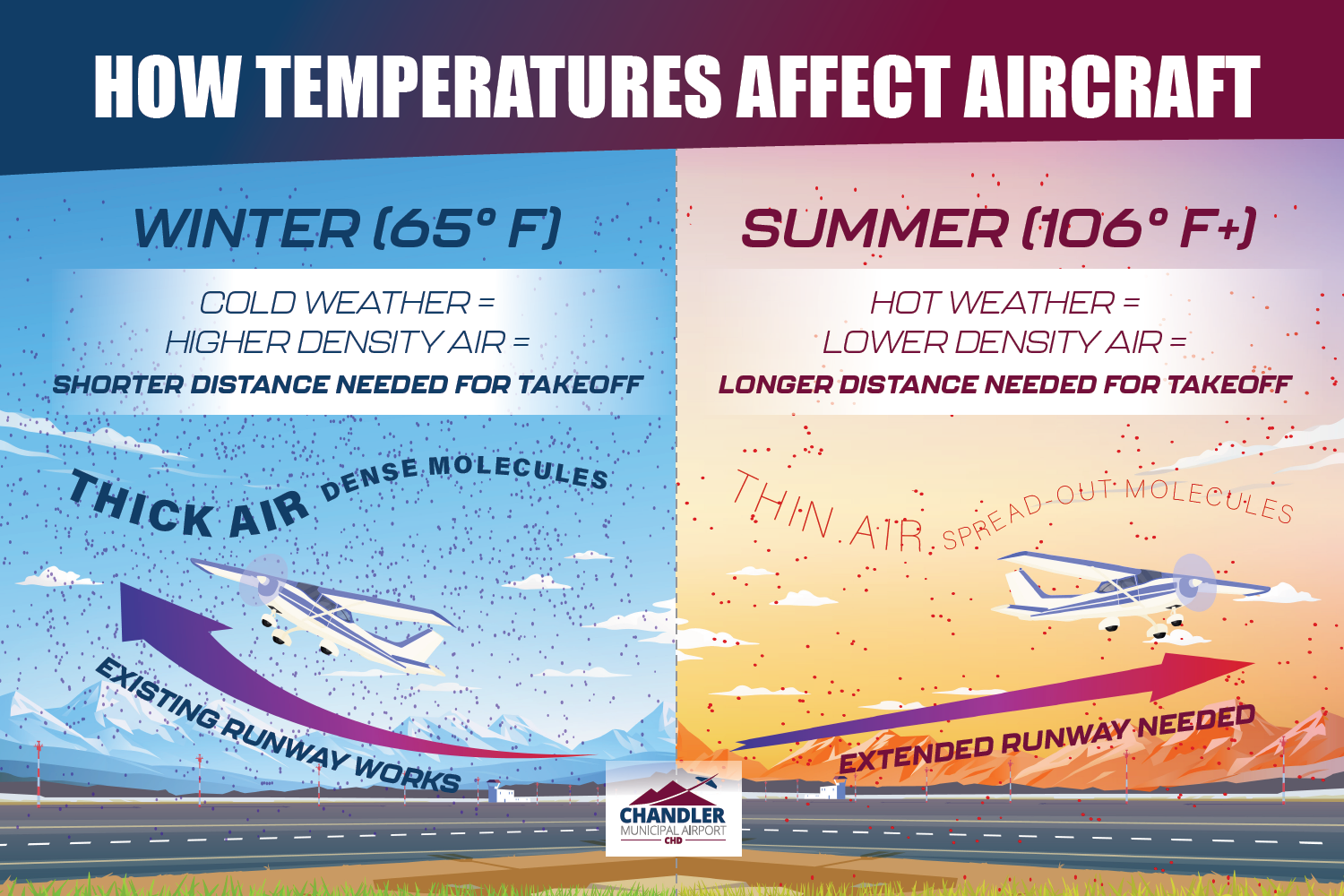
To take off, an aircraft must reach a speed that allows its wings to generate enough lift to leave the ground. The amount of runway required depends on aircraft weight, air temperature, air density, and wind conditions. In hotter conditions, air becomes less dense, which means aircraft require more runway to safely reach takeoff speed.
High temperatures reduce air density, which affects both engine performance and wing lift. In Arizona summers, this effect is especially pronounced and can significantly increase the runway length required for safe takeoff. In summary, when temperatures climb, the air thins out, giving engines less oomph and wings less lift.
In Arizona’s famously toasty summers, this effect becomes especially dramatic, stretching out the runway distance an aircraft needs to get airborne. This is why runway length is particularly important at airports in hot climates like Chandler.
Chandler Municipal Airport: Runway
The City of Chandler is evaluating a proposal to extend Runway 4R/22L at Chandler Municipal Airport from its current length of 4,870 feet to 5,550 feet. This is a modest extension intended to improve aircraft performance and safety for planes that already use the airport, especially during hot summer conditions.
You can think of the extension as adding a few more strides to a well-worn path so the aircraft that already call Chandler home can take off more comfortably—especially through our sizzling summer days. No new runways, new flight paths, or expansion beyond existing airport property are proposed.
Arizona’s high summer temperatures create high-density altitude conditions, meaning aircraft require more runway to take off safely. On the hottest days, some aircraft that already operate at CHD must reduce fuel or passengers, or avoid flying altogether, because the current runway length limits safe performance. The additional 680 feet provides a safety margin that allows these same aircraft to operate more reliably year-round.
The runway extension is a standards-driven, performance-based improvement that supports existing aircraft, protects local jobs, maintains noise protections, and keeps development within airport boundaries. In other words, it’s not an expansion, not a reinvention, and not a shift in mission. Chandler Municipal Airport remains exactly the airport the community knows—just a touch more efficient, resilient, and equipped to continue supporting our thriving local economy.
No. The runway pavement is already rated for 30,000 pounds single-wheel loading, which supports the aircraft that currently use the airport. The extension does not increase allowable aircraft weight, and no strengthening of existing pavement is planned. This confirms the project does not enable heavier or larger aircraft.
No. All runway extension improvements remain entirely within existing airport property. No homes or off-airport businesses are affected, and no land acquisition is required.
The Runway Protection Zone for Runway 22L will shift slightly but will remain fully on airport property. No surrounding neighborhoods or businesses are impacted by RPZ changes.
No. The runway extension does not change the type or size of aircraft that can use CHD. The airport will continue to welcome the same general aviation crowd it always has, from nimble propeller planes to polished business jets like Cessna Citations and King Air turboprop planes.
In aviation terminology, the airport will remain designed for general aviation and small to mid-sized business aircraft, such as Cessna Citation jets and King Air turboprops. Larger commercial aircraft like Boeing 737s or Airbus A320s require far stronger pavements and different runway design standards, which CHD does not have and is not planning to build.
No. Chandler Municipal Airport does not have airline terminals, Part 139 airline certification, heavy-duty pavements, or the runway safety areas required for commercial airline operations.
The Airport’s Master Plan clearly states that airline service is not planned or desired. Even with a longer runway, the airport’s pavement strength and design standards remain unchanged and unsuitable for airliners. Even with a slightly longer runway, the airport’s runway strength and design stay exactly the same, keeping airliners firmly out of the picture and preserving CHD’s small airport charm.
The project is not intended to increase flight volume. It is designed to support safer and more reliable operations for existing users, particularly during extreme summer heat. The number of aircraft, the types of operations, and flight patterns are expected to remain consistent with current activity.
Noise studies show that noise contours remain south of Germann Road, even with the runway extension. No residential neighborhoods are expected to fall within the FAA’s 65 dB noise contour. In some cases, longer takeoff runs can actually allow aircraft to climb more efficiently, potentially reducing noise exposure on the ground. And there’s a small bonus: when aircraft have a bit more runway to work with, they can often climb more smoothly, efficiently, and just a bit more quietly.
No. The extension does not introduce new flight paths or shift traffic over new neighborhoods. Aircraft will continue to arrive and depart using the same general patterns that exist today.
CHD has an established Noise Compatibility Program, including a Noise Hotline, ongoing coordination with air traffic control, voluntary noise-abatement procedures, and public outreach. The airport also keeps an open line with the community, monitoring operations and listening to feedback so it can address concerns with care and consistency as part of its long-standing noise management efforts.