
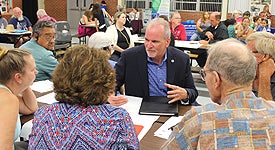


Mediation allows Chandler residents to voluntarily participate in a neighbor-to-neighbor conflict resolution process outside of a court system. A mediator is present at all times to ensure, and moderate, active and engaging discussion that seeks a resolution. Through well-trained mediators, residents can be assured that they will not only be able to express their concerns and viewpoints but will also work in conjunction with the mediator to brainstorm, discuss, and eventually find a solution that is long-lasting and thorough.
Mediation services are currently being offered in partnership with the ASU Sandra Day O’Connor College of Law Lodestar Mediation Clinic at no cost to residents and are flexible in the nature of the dispute as well as the timeline for sessions.
Examples of Neighbor-to-Neighbor Conflicts
- HOA Conflicts
- Property Maintenance Issues
- Noise Issues
Information provided on the Mediation Interest Form may be subject to public information requests.
Purpose of Mediation
Mediation is a voluntary, confidential process where a neutral third party (the mediator) helps disputing parties (Chandler residents) communicate and negotiate to reach a mutually acceptable agreement. Unlike a judge or an arbitrator, the mediator does not impose a decision but guides the conversation toward a constructive resolution.
The purposes of mediation include:
- Encouraging respectful conversation, understanding, and cooperation in resolving neighborhood or community-related issues.
- Allowing people to identify concerns, explore options, and work together toward mutually acceptable solutions or new perspectives.
- Supporting problem-solving without assigning blame or determining fault.
- Providing a voluntary, structured, and confidential process to assist in settling a dispute or to communicate the issue more clearly.
- Offering an alternative to formal complaints, enforcement actions, or court proceedings.
Mediation Process
- Complete the Mediation Interest Form.
- Neighborhood Programs staff will email you an intake form.
- Neighborhood Programs will email intake form to other party.
- When both intake forms are received back, they will be forwarded to the mediation team at Lodestar Mediation Clinic.
- Mediation staff will be in touch, via email address provided, to schedule mediation date and time.
The mediator does not make decisions or recommend outcomes for the parties but leads the discussion to help the parties find their own solutions. Mediation is faster, less expensive, and less formal than going to court.
All residents of the City of Chandler, age 18 and above, are eligible to participate in the Mediation Program.
Examples of disputes include Homeowner Landlord/Tenant issues, HOA conflicts, nuisance complaints, and neighbor-to-neighbor conflicts. Mediation is not provided for domestic disputes or for disputes with a Chandler business. Contact Chandler Neighborhood Programs if you are unsure if your conflict is eligible for mediation.
First, the resident fills out and submits the Mediation Interest Form on the Neighborhood Programs’ webpage to request mediation. Then, Neighborhood Programs’ staff review the request and send the requestor the Intake Form, where the pertinent information for the mediation is collected. Once Neighborhood Programs receives this intake form back from the requestor, they will send an intake form to the other party to confirm their willingness to participate. After receiving both intake forms and confirming the mediation request meets the program’s eligibility requirements, the information is sent to the mediator who will then contact each participant to discuss the mediation process and schedule the session.
The mediation session will typically start with a “joint session,” where the parties each have an opportunity to explain their side and discuss the issue together. If needed, the mediator may meet with each party one-on-one in a session called a caucus. If the mediator decides to caucus, both parties will be given the opportunity to speak with the mediator individually. If the parties agree on a solution, the mediator will draft a legally binding contract that is signed by both parties.
The entire mediation process is voluntary and either party may choose to end the mediation at any time.
Sessions can run between 1-3 hours. Additionally, mediation may be broken into multiple sessions, depending on people’s needs.
Mediations are conducted virtually using Zoom. However, in-person meetings can be arranged at the Neighborhood Programs Building, 235 S. Arizona Ave., if needed. The mediator will coordinate the exact time and location of the mediation based on everyone’s availability.
Mediation is free for Chandler residents.
No, participation in the mediation process is voluntary. Neighborhood Programs offers the mediation service to give residents a respectful and structured space for open dialogue and problem solving.
If the parties reach an agreement, they may sign a contract. This contract will be legally binding like any other contract.
Under state law (A.R.S. 12-2238) mediation is confidential. This means the parties and the mediator must not share any information about what anyone said during the mediation at any point after the mediation. The situation giving rise to the mediation and documents already in existence surrounding the situation (such as a lease or HOA agreement) will not become confidential if they are discussed. Exceptions to the general rule of confidentiality include threats or acts of violence and the terms of the agreement itself.
Neighborhood Programs offers mediation as an option to solve problems outside of the court system. The city acts as an organizer only. All mediation sessions are hosted and moderated by the ASU Law School’s Lodestar Mediation Clinic.
The City of Chandler maintains a record of only the information supplied on the original Mediation Interest Form. Relevant applications or systems may also be updated to reflect the outcome.
No. The only people who are allowed to be a part of the mediation are the people having the disagreement. However, your spouse or one emotional support companion may attend.